Global Rules tab
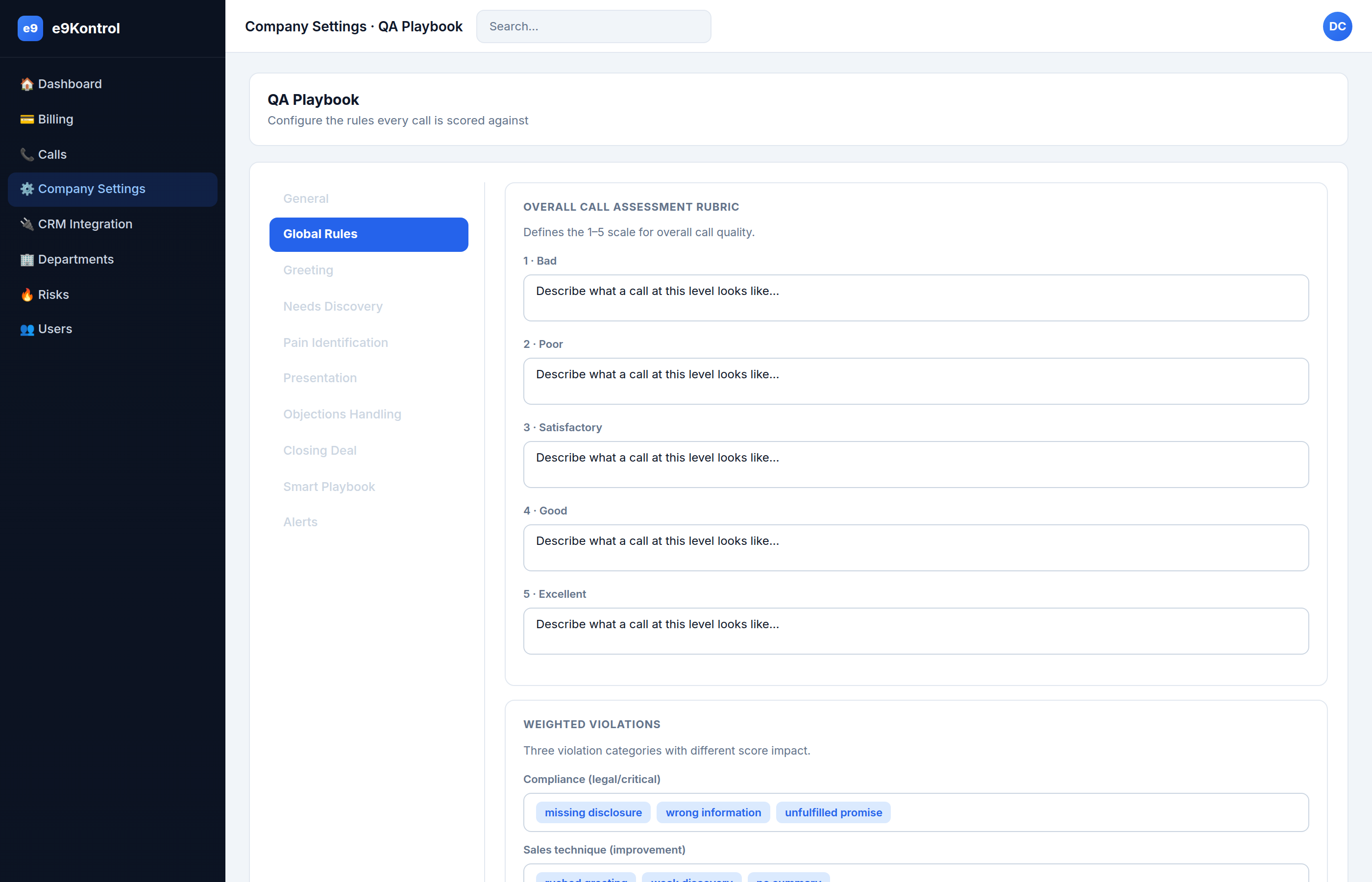
The Global Rules tab defines the rules that apply across all stages.
Overall call assessment rubric
Five fields (1–5) that describe what a call looks like at each overall quality level. The AI maps each call to one of these.
- 1 · Bad — describe a call that failed entirely.
- 2 · Poor — several important misses.
- 3 · Satisfactory — acceptable but nothing special.
- 4 · Good — solid, few gaps.
- 5 · Excellent — a model call.
Example (level 5): "The agent followed every step, handled objections confidently, and closed with a clear next step."
Weighted violations
Three categories with different score impact:
| Field | What it is | Example |
|---|---|---|
| Compliance (legal/critical) | Mandatory rules — heaviest penalty. | missing disclosure, wrong information |
| Sales technique (improvement) | Coaching opportunities. | rushed greeting, weak discovery |
| Hard-fail triggers | Critical violations that fail the call outright. | insult, legal threat, refusal to serve |
Best practice: keep hard-fail triggers rare and unambiguous — these fail a call no matter how good the rest was.
Call difficulty metric
Five levels (Easy → Extreme) that describe how hard a call was. A perfect call with a hostile client is worth more than a perfect call with an easy one.
Best practice: describe difficulty in observable terms (client was rushed, aggressive, or highly informed), not just "hard".
Lead ranks
Four fields that define what qualifies a lead as Hot, Warm, Cold, or Unqualified. Calls are classified into these ranks after analysis.
Best practice: align the definitions with how your sales team actually prioritizes leads, so the rank badges match reality.